Skyonix is a DevOps automation and cloud infrastructure company working across AWS, Azure, GCP, and Akamai Cloud, running managed platform engineering and DevOps retainers for SaaS, AI/ML, and enterprise clients. This guide reflects the pricing structures and scope decisions we see across live engagements in the Indian market.
Executive Summary
- Platform engineering retainers in India typically run ₹1.5L–18L+ per month, depending on cloud footprint, on-call coverage, and team seniority — not a flat industry rate.
- Three pricing models dominate: flat monthly fee, dedicated-pod/staff-augmentation pricing, and outcome-linked hybrid (rare, but growing for FinOps-heavy engagements).
- A fully-loaded in-house platform team (salary + PF + gratuity + recruiter fees + tooling) usually costs 30–45% more than the base salary number suggests and takes 2–4 months to hire.
- The retainer model wins on speed to start, on-call coverage, and avoiding single-person dependency; in-house wins on deep product context and headcount above ~6–8 engineers.
- This article is for CTOs, VPs of Engineering, and founders in India evaluating whether to hire platform engineers directly or bring in a managed retainer, not for job seekers researching platform engineer salaries.
1. What Is a Platform Engineering Retainer?
A platform engineering retainer is a recurring monthly engagement where an external team builds and operates your internal developer platform: CI/CD pipelines, Kubernetes/container infrastructure, infrastructure-as-code, observability, and golden-path tooling — instead of you hiring that capability in-house. You pay a fixed or tiered monthly fee for a defined scope and a named team, rather than per-project invoices or full-time salaries.
It sits between two other models people often confuse it with: Platform Engineering vs. DevOps Consulting.
| Platform Engineering Retainer | DevOps Consulting |
|---|---|
| Ongoing, monthly | Often project-based, fixed-end |
| An operated, evolving internal platform | One-time setup, migration, or audit |
| Same pod every month | Consultants may rotate |
| Flat or tiered monthly retainer | T&M or fixed project quote |
| Best for indefinite platform ownership | Best for one specific fixed problem |
If a vendor can't tell you who's on your account next month, you've been sold consulting hours dressed up as a retainer.
2. Platform Engineering Retainer Cost in India: Pricing by Tier
There's no single number here: quoting "₹X/month for platform engineering" without scope is meaningless. What matters is what's funded at each price point.
Foundation Tier — ₹1.5L–3.5L/month
Best for: early-stage startups and SMBs on single-cloud, pre-scale workloads.
- Single-cloud infrastructure-as-code (Terraform/Pulumi) for one environment
- CI/CD pipeline setup and maintenance (1–2 pipelines)
- Basic monitoring and alerting (uptime, error rate, resource usage)
- Shared/pooled engineer access, not a named dedicated resource
- Business-hours support, async response
Growth Tier — ₹4L–8L/month
Best for: scaling SaaS/fintech/product teams with real reliability needs.
- Kubernetes/container orchestration, multi-environment (dev/staging/prod)
- Named lead + 1–2 engineers with part-to-full allocation
- CI/CD pipeline ownership across services, not just setup
- Observability stack (logs, metrics, traces) with on-call rotation during extended hours
- FinOps basics, cost visibility dashboards, rightsizing recommendations
- Monthly strategic review with engineering leadership
Enterprise Tier — ₹9L–20L+/month
Best for: 24x7 critical systems, multi-cloud operations, and regulated sectors.
- 24x7 on-call with defined SLAs
- Multi-cloud or hybrid-cloud management (AWS + Azure/GCP, or Akamai edge)
- Dedicated pod: 1 senior lead + 2–4 engineers, not shared
- Security and compliance support (SOC 2 / ISO 27001-aligned practices, access governance)
- Advanced FinOps, chargeback models, anomaly detection, budget governance
- Disaster recovery and backup architecture
- AI/MLOps infrastructure support where relevant (model deployment pipelines, GPU cluster management)
| Tier | Monthly Retainer | Team Shape | On-call | Typical Stage |
|---|---|---|---|---|
| Foundation | ₹1.5L–3.5L | Shared/pooled | Business hours | Pre-seed to seed |
| Growth | ₹4L–8L | Named lead + 1–2 engineers | Extended hours | Series A–C |
| Enterprise | ₹9L–20L+ | Dedicated pod, 3–5 engineers | 24x7 | Enterprise and regulated |
These ranges are indicative, built from current Indian platform engineering salary benchmarks plus standard delivery overhead, not a rate card. Your actual number depends on cloud spend, team seniority mix, and compliance load.
3. How Platform Engineering Retainer Pricing Is Structured
1) Flat Monthly Retainer
A fixed fee for a pre-agreed scope, billed every month regardless of infrastructure volume that period. Cleanest for budgeting when your footprint is relatively stable month to month.
2) Dedicated Pod / Staff Augmentation Pricing
You pay for a named team (for example, one senior platform engineer plus one mid-level engineer) at a monthly rate, delivered as a packaged team rather than individual contractor placements.
3) Hybrid: Flat Floor + Usage/Outcome Component
Less common in platform engineering than performance marketing, but used in FinOps-heavy retainers: a flat base fee plus a variable component tied to verified savings or SLA performance.
What to avoid: retainers priced purely as “X hours per month” with no defined on-call commitment or named team.
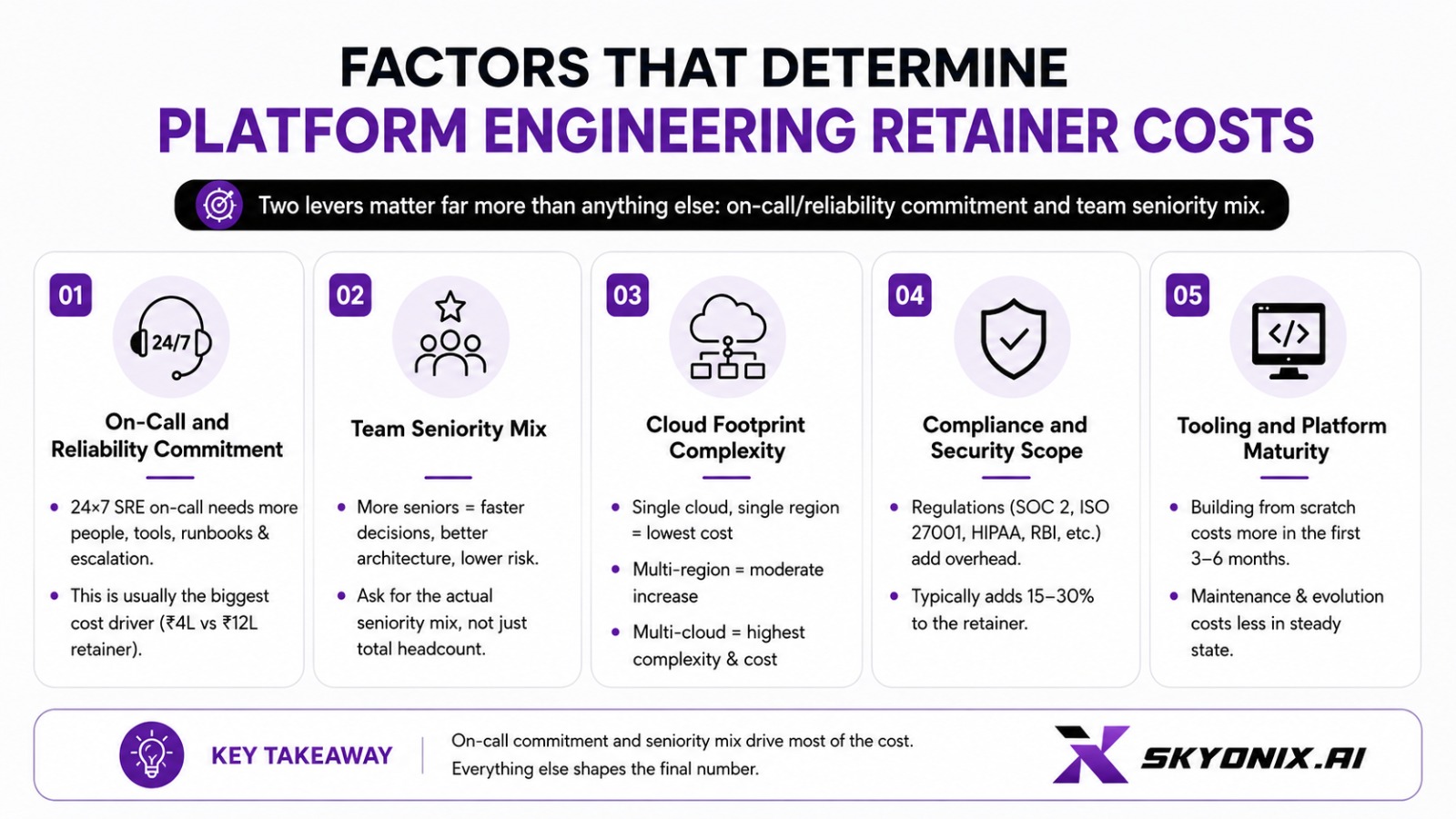
4. Factors That Determine Platform Engineering Retainer Costs
On-Call and Reliability Commitment
Business-hours support and 24x7 SRE-grade on-call are not the same product. A 24x7 rotation needs enough engineers to avoid burnout, plus incident tooling, runbooks, and escalation paths.
Team Seniority Mix
A junior-heavy team costs less but moves slower on architecture decisions and incident response. A team with 2+ senior platform/SRE engineers costs more but reduces long-term risk.
Cloud footprint complexity
- Single cloud/single region: lowest complexity
- Single cloud/multi-region: moderate complexity
- Multi-cloud: highest complexity and coordination overhead
Compliance and Security Scope
SOC 2, ISO 27001-aligned, HIPAA-adjacent, or RBI-regulated environments typically increase cost by 15–30% due to governance and documentation burden.
Current maturity
Building a developer platform from zero (no IaC, no CI/CD, manual deployments) costs more in the first 3–6 months than maintaining and evolving an already-mature platform. Ask whether your quote reflects a build phase versus a steady-state operating phase: these should usually be priced differently.
5. In-House Team vs Outsourced Retainer vs Freelancers
This is where most cost comparisons go wrong; they compare a retainer fee against a single salary number, which understates in-house cost significantly.
Hidden in-house cost layers
- 12% employer PF contribution
- ~4.81% gratuity accrual
- Recruiter/platform fees (8–25% of annual CTC)
- Onboarding, tooling, and hiring-cycle opportunity cost
| Cost Layer | In-House (3-person team) | Growth-Tier Retainer |
|---|---|---|
| Base cost | ~₹54L/year | ₹48L–96L/year |
| Statutory overhead | +~17% of basic | Included |
| Recruitment cost | +8–25% one-time | None |
| Time to start | 2–4 months | Days to 2–3 weeks |
| Attrition/backfill risk | You own it | Provider owns continuity |
Honest caveat: at the lower end of growth tier, a retainer can cost more than a lean in-house team if scope is genuinely simple. The model usually wins once you account for hiring time, attrition risk, and on-call continuity.
Where Freelancers Fit
Freelance or contract platform engineers can be cheaper per hour, but often introduce three risks: no on-call continuity, inconsistent documentation, and no institutional accountability during critical incidents.
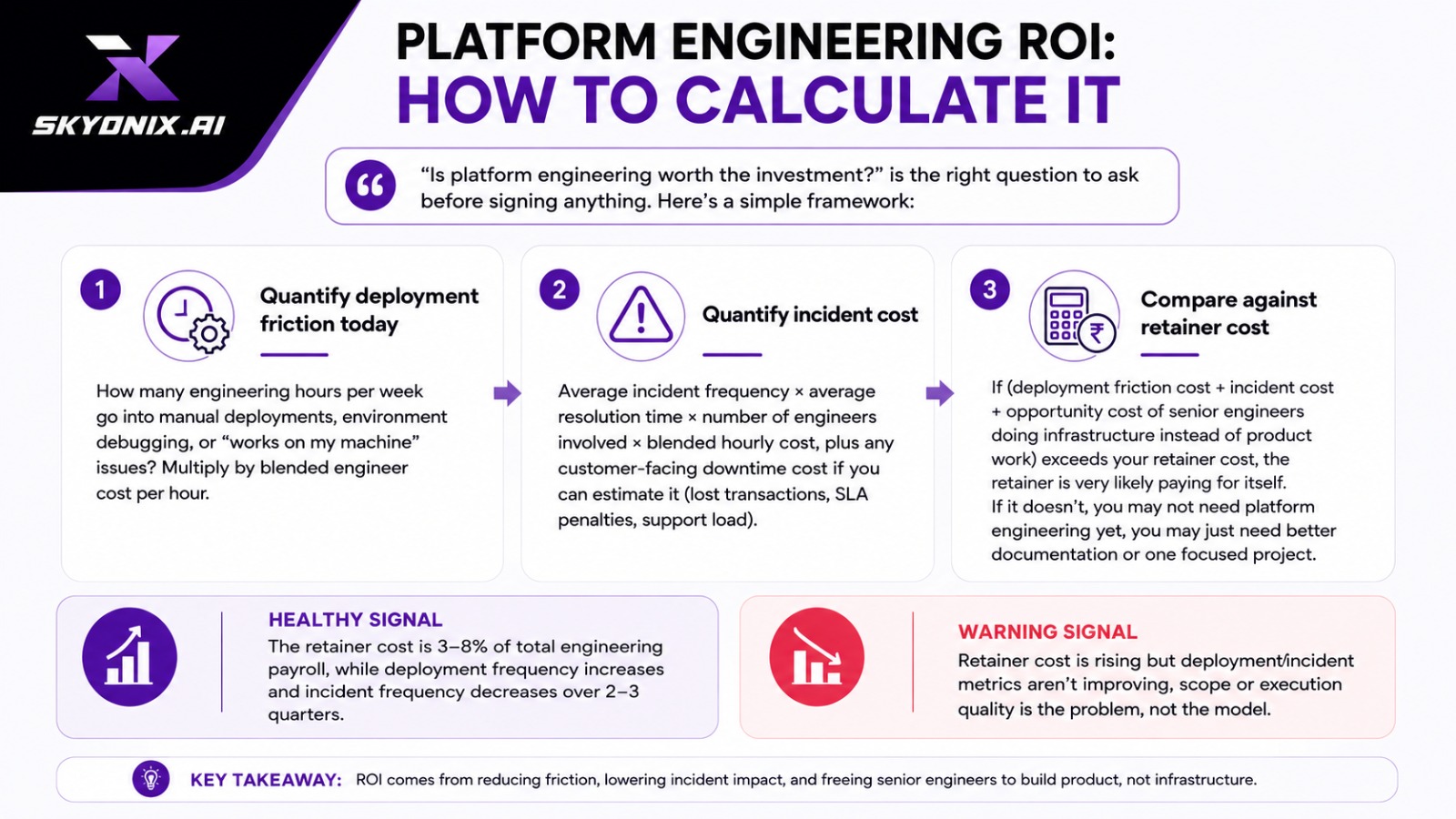
6. Platform Engineering ROI: How to Calculate It
- Quantify deployment friction: weekly infra/debug time x blended engineer hourly cost.
- Quantify incident cost: incident frequency x MTTR x engineers involved x hourly cost.
- Compare vs retainer: if friction + incident + opportunity costs exceed retainer, ROI is usually positive.
| Signal | What It Means |
|---|---|
| Healthy Signal | The retainer cost is 3–8% of total engineering payroll, while deployment frequency increases and incident frequency decreases over 2–3 quarters. |
| Warning Signal | Retainer cost is rising but deployment/incident metrics aren't improving, scope or execution quality is the problem, not the model. |
7. Worked Example: What a Mid-Market SaaS Company Gets for ₹4.5L/Month
Illustrative scenario: a 40-person SaaS team on AWS with dev/staging/prod, manual deployments, and no dedicated platform headcount.
- CI/CD migration across services (month 1–2)
- Terraform-managed infrastructure
- Centralized logging and alerting
- Extended-hours on-call with escalation path
- Monthly cloud review and rightsizing
Typical timeline: discovery in weeks 1–2, build-out through weeks 3–8, steady-state from month 3.
8. Platform Engineering Team Structure and Costs
| Role | Typical Annual Compensation (India) | Ownership in Retainer |
|---|---|---|
| Platform/DevOps Engineer (Mid) | ₹9L–16L | Pipelines, IaC changes, day-to-day ops |
| Senior Platform/SRE Engineer | ₹20L–35L+ | Architecture and incident leadership |
| Platform Engineering Lead | ₹30L–45L+ | Roadmap and stakeholder alignment |
| FinOps Specialist | ₹14L–25L | Cost governance and anomaly controls |
9. Questions to Ask Before Signing a Retainer
- Who will be responsible for managing my platform engineering account?
- What's the on-call commitment in writing?
- Is this a build phase or a steady-state phase, and is pricing different?
- What happens to my infrastructure if I leave?
- How is cloud spend reported? Is there any cloud bill markup?
- What's the escalation path during incidents and your mean-time-to-acknowledge?
- Can you show a redacted monthly report or review deck?
If a vendor hesitates on more than one of these, that's your answer.
10. How Skyonix Prices Platform Engineering Retainers
Skyonix runs platform engineering retainers under its automation, DevOps, and cloud infrastructure practices, with optional FinOps governance and AI/MLOps support. Every engagement starts with a complimentary cloud infrastructure assessment so pricing maps to your actual environment, not generic assumptions.
For a scoped quote, use the contact form or email connect@skyonix.ai. Most clients begin with a narrower pilot scope before expanding to full managed ownership.
11. Frequently Asked Questions
1. What is the typical platform engineering retainer cost in India?
Most platform engineering retainers in India range from ₹1.5L to ₹20L+ per month, depending on team size, on-call coverage, and cloud complexity. Foundation-tier engagements for early-stage companies start around ₹1.5L–3.5L/month; enterprise-grade 24x7 coverage runs ₹9L–20L+/month.
2. How are platform engineering retainer fees structured by Indian firms?
Indian providers generally use a flat monthly fee, a dedicated-pod/staff-augmentation rate tied to named team capacity, or occasionally a hybrid model with a flat floor plus a variable component tied to cost savings or SLA performance. Flat and pod-based pricing are far more common than pure usage-based billing.
3. What is included in a standard platform engineering retainer package from Indian providers?
A standard package typically includes CI/CD pipeline ownership, infrastructure-as-code management, monitoring and alerting, a defined on-call commitment, and a monthly or quarterly strategic review. Higher tiers add multi-cloud management, security/compliance support, and FinOps cost governance.
4. Which companies offer platform engineering retainer services in India?
The market includes boutique DevOps and cloud-native consultancies, larger IT services firms with dedicated platform practices, and specialized managed cloud providers like Skyonix. The right fit depends less on company size and more on whether their existing client base matches your scale and compliance needs.
5. What factors influence platform engineering retainer pricing in India?
The biggest drivers are on-call/reliability commitment (business hours vs. 24x7), team seniority mix, cloud footprint complexity (single-cloud vs. multi-cloud), and compliance scope (SOC 2, ISO 27001-aligned, regulated industries). Tooling maturity also matters; building a platform from zero costs more than operating an existing one.
6. How should I compare platform engineering retainer pricing in India?
Compare on scope and team composition first, price second. Ask each vendor for named team seniority, exact on-call SLA, and whether cloud spend is marked up. Two retainers at the same price can represent very different actual capacity.
7. What are typical hourly rates for platform engineering specialists from Indian agencies?
Based on monthly retainer ranges and typical allocation, effective rates generally fall between ₹1,500 and ₹4,500/hour for mid-level engineers and ₹4,000–₹8,000+/hour for senior platform/SRE specialists, though most agencies bill via monthly retainer rather than hourly.
8. What are the best platform engineering retainer packages available in India?
There's no universal best package — the right one matches your on-call needs and cloud complexity. As a rule of thumb: Foundation (₹1.5L–3.5L/month) for pre-scale startups; Growth (₹4L–8L/month) for scaling SaaS/fintech; Enterprise (₹9L–20L+/month) for regulated or 24x7-critical environments.
9. Is platform engineering worth the investment?
It's worth it when deployment friction, incident frequency, and senior engineers' time spent on infrastructure (instead of product work) cost more than the retainer itself. Pre-product-market-fit companies often do not need a full ongoing retainer yet.
10. When should companies use platform engineering services?
Most companies benefit once they have 2+ services in production, more than 5–8 engineers, or uptime/compliance requirements that a single founder-engineer cannot realistically cover solo.
11. Platform engineering vs. DevOps consulting: what's the difference?
DevOps consulting is typically a fixed-scope, time-boxed engagement (for example, CI/CD setup or migration). A platform engineering retainer is an ongoing recurring engagement where the same team continues operating and evolving infrastructure over time.
12. How does platform engineering reduce cloud costs?
Through rightsizing overprovisioned resources, eliminating idle infrastructure, implementing autoscaling correctly, and adding cost-visibility dashboards that catch anomalies early. FinOps-focused retainers commonly identify 15–25% recoverable spend in unmanaged accounts.
13. What is the salary of a platform engineer in India?
According to 2026 India salary datasets, average platform engineer salary is roughly ₹10.5L–13L annually, with senior platform/SRE engineers in metro hubs often earning ₹20L–35L+ depending on specialization and company tier.
14. How much does it cost to hire an engineer in India beyond salary?
Beyond salary, budget an additional 25–45% for statutory costs (12% PF, ~4.81% gratuity), one-time recruiter fees (8–25% of annual CTC if agency hired), and onboarding/tooling costs.
15. Platform engineering retainer ROI calculator: how do I estimate it myself?
Add weekly engineering hours lost to deployment friction and incident resolution, multiply by blended hourly cost, and compare that against monthly retainer fee. If friction cost exceeds retainer cost, the engagement is likely paying for itself.
12. Conclusion
Platform engineering retainer cost in India is not a single number. It is a function of reliability expectations, team seniority, cloud complexity, and compliance requirements, usually landing between ₹1.5L and ₹20L+ monthly.
The comparison that matters is not “retainer vs one salary,” but fully-loaded in-house operating cost versus a scoped, named-team retainer with clear on-call accountability.
Get a complimentary cloud infrastructure assessment from Skyonix to get a scoped estimate for your environment.