About the Author
Vishal Shinde — Founder & CEO, Skyonix Technologies
Vishal Shinde is the Founder and CEO of Skyonix Technologies, a cloud infrastructure and DevOps services company. He has helped over 50 startups and growing businesses design, automate, and manage their CI/CD pipelines, Kubernetes clusters, and multi-cloud infrastructure. Through this experience, he has gained firsthand insight into which companies benefit most from DevOps-as-a-Service and which genuinely require an in-house DevOps team.
TL;DR — Key Takeaways
- DevOps as a Service (DaaS) is a model where a third-party provider delivers DevOps capabilities — CI/CD, cloud infrastructure, monitoring, automation — as an ongoing managed service, instead of you hiring a full in-house team.
- It makes the most sense for startups, SaaS companies, and growing businesses that need DevOps expertise now but can't yet justify 2–4 full-time hires (~$130K–$200K+ each annually in the US).
- It does NOT replace in-house DevOps for companies with extreme compliance needs, 24/7 mission-critical systems requiring on-call ownership, or deeply proprietary infrastructure knowledge that can't be externalized.
- The global DevOps market is projected to grow from $16.13B in 2025 to over $47–51B by 2030–2031 (21–26% CAGR) — and the services segment specifically is growing faster than tooling, at roughly 23% CAGR.
- Most companies don't choose between 100% in-house or 100% outsourced—the highest-performing setup is usually hybrid: a lean internal lead plus a DaaS partner for execution depth.
- The #1 mistake businesses make: treating DevOps as a service like a one-time project instead of an ongoing operating model.
1. What Is DevOps as a Service?
DevOps as a Service (DaaS) is a delivery model in which a third-party provider supplies the people, tools, and processes needed to build, automate, and operate your software delivery pipeline and cloud infrastructure—on an ongoing basis, as a managed service rather than a one-time project.
In plain terms: Instead of hiring your own DevOps engineers, building your own tooling stack, and managing your own on-call rotation, you pay a specialized provider to do this for you—continuously, not just once.
DevOps as a Service typically includes:
- CI/CD pipeline design, automation, and maintenance
- Cloud infrastructure provisioning and management (AWS, Azure, GCP)
- Infrastructure as code (Terraform, CloudFormation, Pulumi)
- Containerisation and orchestration (Docker, Kubernetes)
- Monitoring, logging, and observability (Prometheus, Grafana, ELK)
- Security integration — DevSecOps practices baked into the pipeline
- Cost optimisation and cloud governance
- Incident response and on-call support (in various models)
DevOps as a Service vs. DevOps Consulting: What's the Difference?
This is a common point of confusion. DevOps consulting is typically a fixed-scope engagement — a consultant assesses your setup, recommends changes, and leaves. DevOps as a Service is the ongoing version: the provider doesn't just recommend improvements to your CI/CD pipeline; they build it, run it, and keep improving it month after month, functioning as an extension of your team.
| Model | Engagement Type | Duration | Best For |
|---|---|---|---|
| DevOps Consulting | Project-based, fixed scope | Weeks to a few months | One-time audits, migrations, and architecture reviews |
| DevOps as a Service | Ongoing managed service | Continuous (monthly/retainer) | Day-to-day operations, scaling, and long-term ownership |
| Staff Augmentation | Embedded contractor(s) | Variable, often 6+ months | Filling a specific skill gap on your existing team |
| Full In-House Team | Direct employment | Permanent | Mission-critical, highly regulated, large-scale ops |
2. How DevOps as a Service Actually Works?
Here is the typical engagement flow, step by step, based on how most reputable DaaS providers operate:
- Discovery & Infrastructure Audit — The provider reviews your current architecture, pipelines, cloud spend, and pain points. (Typically 1–2 weeks)
- Roadmap & Scope Definition — A prioritized plan is built: what gets fixed first, what gets automated, and what tooling is introduced. (Typically 1 week)
- Implementation — CI/CD pipelines are built or improved, infrastructure is codified (IaC), monitoring is set up, and security gates are added. (4–12 weeks depending on complexity)
- Stabilization & Handover Documentation — The new systems are documented, your internal team (if any) is trained, and runbooks are created.
- Ongoing Management — The provider continues to monitor, maintain, optimise costs, patch, and scale the infrastructure as your product grows. This is the 'as a service' part—it doesn't stop after go-live.
Pro tip: Ask any DevOps-as-a-Service provider what happens after the initial 90 days. If their answer is vague, you're talking to a consulting shop wearing a DaaS label, not a true managed service provider.
Typical Monthly Engagement Includes
- Infrastructure monitoring and incident response (SLA-backed)
- Continuous pipeline improvements and new environment provisioning
- Monthly cloud cost optimisation reviews
- Security patching and compliance checks
- A dedicated point of contact or small team (not a rotating call centre)
- Regular reporting — uptime, deployment frequency, incident metrics
3. Why DevOps Breaks Down as Companies Grow?
Most companies don't plan to need DevOps as a service—they back into it after their internal setup starts cracking under growth. Here's the pattern we see repeatedly:
The Three Failure Points
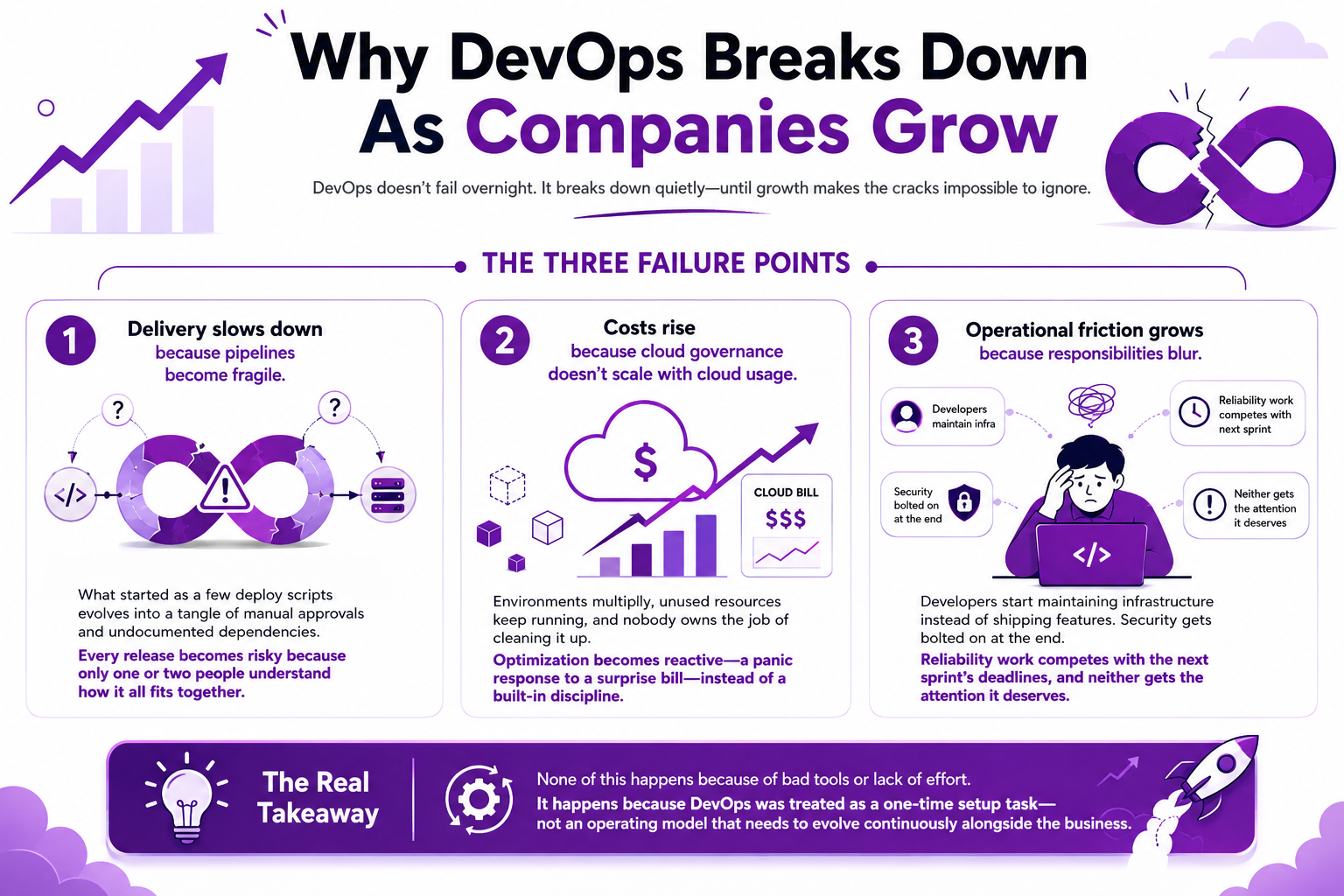
Delivery slows down because pipelines become fragile. What started as a few deployment scripts has evolved into a tangle of manual approvals and undocumented dependencies. Every release becomes risky because only one or two people understand how the whole thing fits together.
Costs rise because cloud governance doesn't scale with cloud usage. Environments multiply, unused resources keep running, and nobody owns the job of cleaning it up. Optimisation becomes reactive—a panic response to a surprise bill—instead of a built-in discipline.
Operational friction grows because responsibilities blur. Developers start maintaining infrastructure instead of shipping features. Security gets bolted on at the end rather than built into the development and deployment process from day one. Reliability work competes with the next sprint's deadlines, and neither receives the attention it deserves.
None of this happens because of bad tools or lack of effort. It happens because DevOps was treated as a one-time setup task—not an operating model that needs to evolve continuously alongside the business.
4. DevOps as a Service vs In-House DevOps vs Hiring DevOps Engineers
This is the comparison most decision-makers actually need. Here's an honest, side-by-side breakdown:
| Factor | DevOps as a Service | In-House DevOps Team | 1 – 2 Hired DevOps Engineers |
|---|---|---|---|
| Time to productivity | 2 – 4 weeks | 3 – 6 months (hiring + ramp-up) | 6 – 10 weeks (hiring + ramp-up) |
| Skill breadth | Wide—the team covers cloud, security, IaC, and monitoring | Wide, if the budget allows 3+ specialists | Narrow—limited by individual expertise |
| Cost predictability | High retainer or fixed monthly fee | Low salaries, benefits, tooling, and attrition risk can make costs unpredictable | Medium — fixed salary but coverage gaps |
| Scalability | Large-scale up/down with business needs | Low—hiring/firing is slow and costly | Low — bottlenecked by 1 – 2 people's bandwidth |
| Institutional knowledge | Medium — depends on provider continuity | High — full ownership and context | High—but knowledge sits in 1 – 2 heads (risk) |
| On-call / 24/7 coverage | Often included or available as an add-on | Requires rotation across multiple hires | Burnout risk — single points of failure |
| Best for | Startups, SaaS, scaling businesses | Large enterprises, regulated industries | Companies with 1 narrow, well-defined need |
5. The Real Cost Comparison: DaaS vs In-House Team
Numbers make this decision concrete. Here is what building a baseline in-house DevOps capability actually costs versus a managed service retainer.
In-House DevOps Team — Annual Cost Breakdown (US Market, 2025–26)
| Role | Average Annual Salary | Notes |
|---|---|---|
| DevOps Engineer (Mid-level) | $128,800 – $159,300 | Core CI/CD and cloud ops |
| Senior DevOps Engineer | $141,700 – $204,219 | Architecture decisions, mentoring |
| DevSecOps Engineer | $153,895 – $187,974 | Security-integrated pipelines |
| Recruiting & onboarding cost | 10–20% of first-year salary | Per hire, often underestimated |
| Benefits, tooling, overhead | 25–40% on top of base salary | Healthcare, equipment, SaaS licenses |
A minimal in-house DevOps capability (2 engineers—one mid-level, one senior) typically costs $270,000–$363,000 per year in fully loaded US salary costs alone, before accounting for tooling, cloud spend, or the 3–6 months required to hire and ramp them up.
DevOps as a Service — Typical Cost Range
| Engagement Size | Typical Monthly Range | What It Usually Covers |
|---|---|---|
| Startup / Small SaaS | $3,000 – $8,000/month | CI/CD, basic cloud management, monitoring |
| Growing Business | $8,000 – $20,000/month | Full pipeline ownership, IaC, cost optimisation, on-call |
| Mid-Market / Complex Infra | $20,000 – $50,000+/month | Multi-cloud, DevSecOps, compliance, 24/7 SLA coverage |
Even at the higher end ($20,000/month = $240,000/year), a DevOps as a Service engagement often delivers broader skill coverage—cloud architecture, security, automation, and cost optimisation—than two full-time hires, without the hiring risk, ramp-up time, or attrition exposure.
This is not a universal rule—at a large scale (10+ engineers' worth of work), in-house ownership usually becomes more cost-efficient. The crossover point is the key question Section 6 answers.
6. Is DevOps as a Service Right for Your Business?
Use this checklist: if you check 4 or more boxes, DevOps as a Service is very likely the right call for your business right now.
The DaaS Fit Checklist
- You need DevOps expertise now, but can't yet justify 2+ full-time salaries
- Your team ships features faster than your infrastructure can safely support
- You don't have anyone in-house who can own cloud architecture decisions
- Your cloud bill is rising, and nobody owns optimising it
- You've had at least one deployment incident caused by manual, undocumented processes
- You're preparing for a fundraising round, audit, or enterprise client that requires infrastructure maturity
- Your engineers are spending more time on infrastructure firefighting than on product features
- You want 24/7 coverage, but can't yet staff a fair on-call rotation internally
Decision Tree: Do you really need a DevOps team?
Ask these three questions in order:
- Do you have predictable, ongoing DevOps work (not just a one-time migration)? → If NO, consider project-based consulting instead of DaaS.
- Is your current or projected infrastructure spend large enough to justify $5,000+/month in dedicated support? → If NO, a part-time contractor may suffice for now.
- Would hiring 2+ full-time DevOps engineers today be premature for your stage or budget? → If YES, DevOps as a Service is very likely your best option.
7. When an In-House DevOps Team Is the Better Choice?
Honesty matters here—DaaS is not universally correct. It is the wrong choice in these situations:
When Outsourcing DevOps May Not Be the Right Choice
- Your infrastructure handles extremely sensitive data (defense, certain healthcare/financial systems) where regulations require in-house personnel with security clearances.
- You are at a scale where you need 5+ full-time-equivalent DevOps engineers — at this size, in-house ownership is usually more cost-efficient and gives better long-term institutional knowledge.
- Your core product IS infrastructure or DevOps tooling itself—this expertise must be a core competency you own directly, not outsource.
- You need engineers embedded in daily stand-ups with a deep, constantly evolving product context that's hard to transfer to an external partner.
- You've had bad experiences with vendors who treated your account as low-priority—in this case, fix vendor selection (see Section 10); don't abandon the model entirely.
The honest reality: most companies live in the middle. A hybrid model—one strong in-house DevOps lead who owns strategy and security, supported by a DevOps as a service partner for execution depth and 24/7 coverage—outperforms either extreme for companies between 10 and 200 engineers.
8. Key Benefits of Outsourcing DevOps
| Benefit | What It Actually Means | Why It Matters |
|---|---|---|
| Faster time-to-value | Skip 3–6 months of hiring and onboarding | You get working pipelines in weeks, not quarters |
| Access to broader skillsets | One provider covers cloud, security, IaC, and monitoring | Hard to find all of this in one or two hires |
| Predictable costs | Fixed monthly retainer vs variable salary/benefits/attrition | Easier to budget and forecast |
| Reduced cloud spend | Dedicated cost optimisation as an ongoing practice | Often pays for a meaningful chunk of the retainer itself |
| Lower attrition risk | Provider continuity isn't tied to one person quitting | No single point of failure on critical infrastructure knowledge |
| Faster scaling | Add capacity during growth spikes without a hiring cycle | Match infra-capability to business momentum |
| Better security posture | DevSecOps practices built in by specialists | Reduces risk of compliance and breach incidents |
9. DevOps as a Service for Startups and SaaS Companies
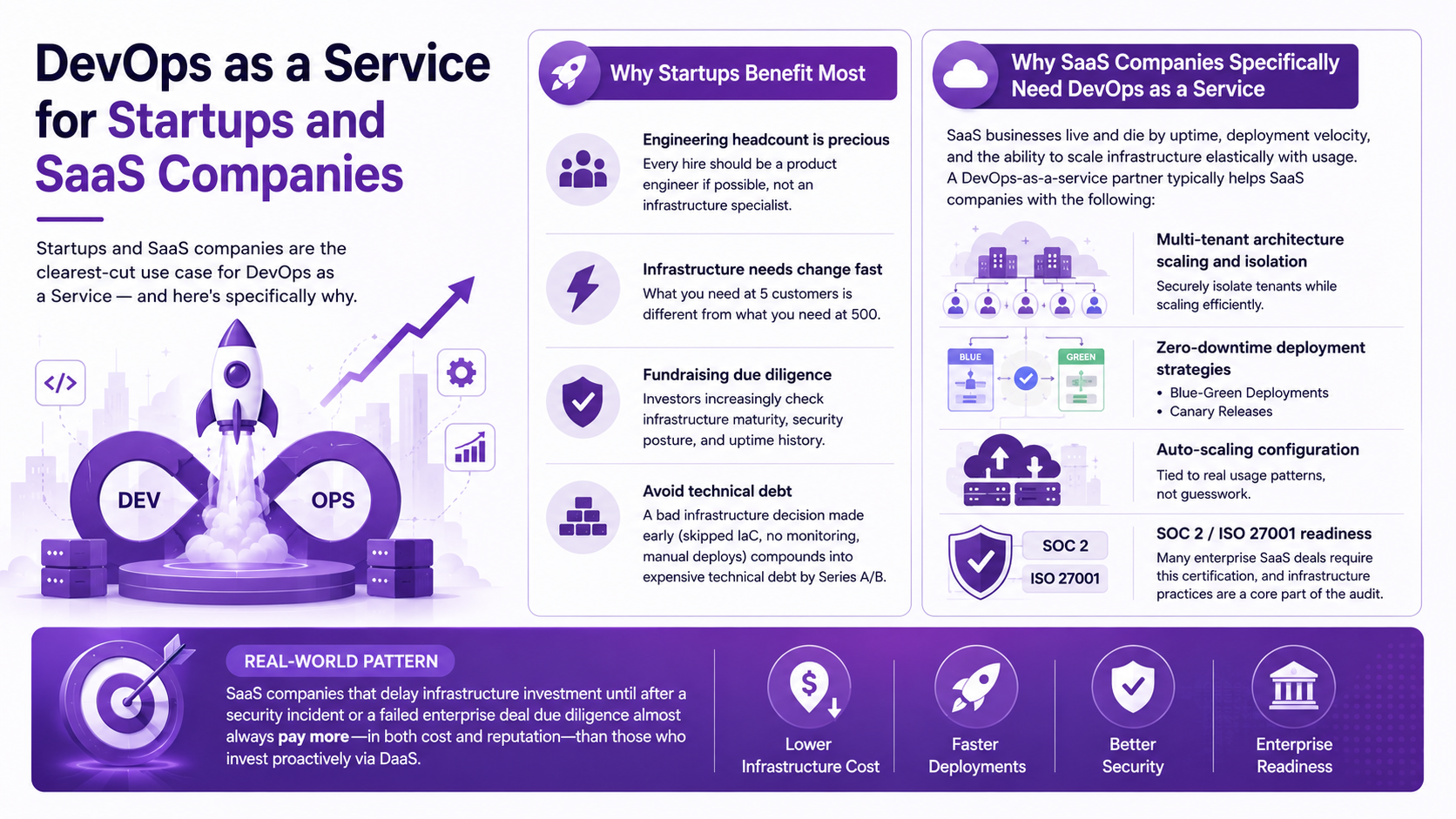
Startups and SaaS companies are the most clear cut use case for DevOps as a Service — and here's specifically why.
Why Startups Benefit Most
- Engineering headcount is precious—every hire should be a product engineer if possible, not an infrastructure specialist.
- Infrastructure needs change fast—what you need at 5 customers is different from what you need at 500.
- Fundraising due diligence increasingly checks infrastructure maturity, security posture, and uptime history.
- A bad infrastructure decision made early (skipped IaC, no monitoring, manual deploys) compounds into expensive technical debt by Series A/B.
Why SaaS Companies Specifically Need DevOps as a Service
SaaS businesses live and die by uptime, deployment velocity, and the ability to scale infrastructure elastically with usage. A DevOps-as-a-service partner typically helps SaaS companies with the following:
- Multi-tenant architecture scaling and isolation
- Zero-downtime deployment strategies (blue-green, canary releases)
- Auto-scaling configuration tied to real usage patterns, not guesswork
- SOC 2 / ISO 27001 readiness — many enterprise SaaS deals require this certification, and infrastructure practices are a core part of the audit
Real-world pattern: SaaS companies that delay infrastructure investment until after a security incident or a failed enterprise deal due diligence almost always pay more—in both cost and reputation—than those who invest proactively via DaaS.
10. How to Choose a DevOps Service Provider?
Selecting the right DevOps-as-a-Service provider is a critical decision that can directly influence your infrastructure reliability, security posture, operational efficiency, and ability to scale. Use the evaluation criteria below to assess potential partners objectively and identify the provider best aligned with your business requirements and long-term goals.
Evaluation Criteria
| Evaluation Criteria | What to Ask | Red Flag Answer |
|---|---|---|
| Technical depth | Can they show real architecture diagrams from past clients? | Only generic marketing case studies, no technical specifics |
| Cloud certifications | Do team members hold AWS/Azure/GCP professional certifications? | No verifiable certifications or experience |
| Communication model | Is there a dedicated point of contact or a rotating support queue? | Different person every time you reach out |
| SLA clarity | What is the guaranteed response time for critical incidents? | Vague language like 'we respond quickly' |
| Security practices | How do they handle access to your cloud credentials? | Reluctance to discuss least-privilege access models |
| Exit strategy | What happens to documentation/access if you leave? | No clear offboarding or knowledge-transfer process |
| Pricing transparency | Is pricing a clear retainer or a vague 'custom scope'? | Pricing only revealed after a lengthy sales process |
| References | Can they connect you with a current client for a reference call? | Unable or unwilling to provide any references |
Questions to Ask in Your First Call
- Walk me through how you'd onboard our infrastructure in the first 30 days?
- What does your team do when something breaks at 2 a.m?
- Can you show me an example of a cost optimisation you delivered for a similar-sized client?
- What happens if we want to bring this in-house in 18 months?
11. Common Misconceptions About DevOps as a Service
"DaaS means losing control of our infrastructure."
Reality: A well-structured engagement gives you full visibility — dashboards, documentation, and access — at all times. You own the infrastructure; the provider operates it on your behalf, similar to how you'd own a building but contract facilities management.
"It's only for companies that can't afford to hire."
Reality: Many well-funded, profitable companies deliberately choose DaaS because it gives them broader, more current expertise than 1–2 hires could provide, without the management overhead of running an internal team.
"AI tools will make DevOps as a service obsolete."
Reality: AI is automating specific tasks within DevOps (config generation, anomaly detection, alert triage) — not replacing the judgment, architecture decisions, and incident ownership that a DaaS provider brings. If anything, the rise of AI-assisted DevOps tooling is making good DaaS providers more efficient and more valuable, not less.
"It's the same as just hiring freelancers."
Reality: Quality DaaS providers offer team continuity, documented processes, and SLA-backed accountability that individual freelancers typically can't guarantee. A freelancer disappearing mid-incident is a real operational risk; a provider with a team structure mitigates that.
12. Is DevOps a Dead-End Career in the Age of AI?
This question comes up often in searches related to DevOps, so it's worth addressing directly and honestly.
Is DevOps a dead-end job?
No, DevOps roles are evolving, not disappearing. The global DevOps market is projected to grow from approximately $16 billion in 2025 to $47–51 billion by 2030–2031—a sustained 21–26% CAGR. The services segment specifically (which includes DaaS) is growing faster than the tooling/software segment, at roughly 23% CAGR. This is not the profile of a dying field.
Is DevOps Still Relevant in 2026?
Yes, but the role is shifting. Manual, repetitive DevOps tasks (writing boilerplate configs and basic monitoring setup) are increasingly automated by AI-assisted tools. What remains — and grows in value — is the judgment layer: architecture decisions, security trade-offs, incident response, and cost strategy. This is precisely the value a strong DevOps as a Service provider brings, and the same evolution applies to in-house DevOps careers.
Will AI replace DevOps engineers?
AI is automating DevOps tasks, not DevOps roles. AI-assisted tools are speeding up config generation, log analysis, and anomaly detection — but they still require a human to set objectives, validate output, and own outcomes when something goes wrong in production. Companies that combine skilled DevOps practitioners (in-house or via DaaS) with AI tooling are outperforming those who try to remove the human judgment layer entirely.
13. How Skyonix Technologies Delivers DevOps as a Service?
Skyonix Technologies provides DevOps as a Service for startups, SaaS companies, and growing businesses that need production-grade infrastructure without the overhead of building a full internal team from scratch.
What's Included in a Skyonix DaaS Engagement
- Initial infrastructure audit and roadmap — no guesswork, a documented plan from week one
- CI/CD pipeline design and implementation (Jenkins, GitHub Actions, GitLab CI)
- Cloud architecture on AWS, Azure, or GCP — provisioned via Infrastructure as Code
- Containerisation and Kubernetes orchestration for scalable, portable workloads
- Monitoring and observability setup (Prometheus, Grafana, centralised logging)
- DevSecOps practices are integrated into every pipeline stage, not bolted on afterward
- Ongoing cloud cost optimisation—reviewed monthly, not just at kickoff
- A dedicated point of contact — not a rotating support queue
Skyonix's approach is built on a simple principle: infrastructure should be invisible when it's working. Our clients should be thinking about their product roadmap, not their pipeline stability.
Need Expert Guidance on Your Cloud & DevOps Strategy?
Get a complimentary Cloud Infrastructure Assessment from Skyonix. Our experts will evaluate your current environment, identify risks and optimization opportunities, and recommend the right approach for your business—without any obligation.
14. Frequently Asked Questions (FAQ)
1. What is DevOps as a Service?
DevOps as a Service (DaaS) is a delivery model where a third-party provider supplies the people, tools, and processes needed to build, automate, and operate your CI/CD pipelines and cloud infrastructure on an ongoing basis — functioning as a managed extension of your team rather than a one-time project.
2. Is DevOps as a Service worth it?
For startups, SaaS companies, and growing businesses that need DevOps expertise but can't yet justify 2+ full-time hires, DevOps as a Service is typically worth it — it delivers broader skill coverage at a more predictable cost than building an equivalent in-house team from scratch. For large-scale operations (5+ FTE worth of DevOps work) or highly regulated environments requiring in-house personnel, in-house ownership is usually the better long-term investment.
3. When should a company use DevOps as a Service?
A company should consider DevOps as a service when infrastructure needs are growing faster than the team can manage manually, there's no in-house owner for cloud architecture decisions, cloud costs are rising without oversight, or the business needs production-grade infrastructure maturity (for fundraising, compliance, or enterprise sales) without a multi-month hiring cycle.
4. How does DevOps as a Service work?
It typically follows five stages: an infrastructure audit, a scoped roadmap, implementation (building or improving CI/CD pipelines and cloud architecture), stabilization with documentation and handover, and then ongoing management—continuous monitoring, optimisation, and support delivered monthly as a retainer-based service.
5. What is the difference between DevOps as a Service and hiring DevOps engineers?
Hiring DevOps engineers means direct employment — fixed salaries, benefits, a multi-month hiring and ramp-up cycle, and skill coverage limited to those specific individuals. DevOps as a Service provides a team's worth of broader skill coverage (cloud, security, automation, monitoring) through a flexible, ongoing retainer, without the hiring overhead or single-point-of-failure risk of relying on 1–2 employees.
6. Should you outsource DevOps or build an in-house team?
This depends on scale and maturity. DevOps as a Service is often the best fit for startups and growing businesses, offering broader expertise at 40–80% lower cost than building an equivalent in-house team. In-house teams make more sense when DevOps is a core competency, regulatory requirements demand direct ownership, or the workload supports 5+ dedicated engineers. Many companies benefit most from a hybrid approach.
7. What are the benefits of outsourcing DevOps?
Key benefits include faster time-to-value (weeks instead of months of hiring), access to broader and more current skill sets, predictable monthly costs versus variable salary and attrition risk, dedicated cloud cost optimisation, reduced single-point-of-failure risk, and improved security posture through specialist DevSecOps practices.
8. How much does DevOps as a Service cost?
Typical monthly costs range from $3,000–$8,000 for startups and small SaaS companies (basic CI/CD and monitoring), $8,000–$20,000 for growing businesses needing full pipeline ownership and on-call coverage, and $20,000–$50,000+ for mid-market companies with multi-cloud, compliance, or 24/7 SLA requirements.
9. Is DevOps as a Service good for startups?
Yes, startups are one of the clearest use cases. It preserves limited engineering headcount for product development, adapts quickly as infrastructure needs change with growth, and helps establish the infrastructure maturity that fundraising due diligence and early enterprise customers increasingly expect.
10. Is DevOps a dead-end job?
No. The global DevOps market is projected to grow from roughly $16 billion in 2025 to $47–51 billion by 2030–2031, a sustained 21–26% CAGR, with the services segment growing even faster at approximately 23% CAGR. DevOps roles are evolving toward higher-judgment work (architecture, security, cost strategy) as routine tasks become AI-assisted — this is a shift in the work, not a disappearance of the field.
11. Will AI replace DevOps as a service or in-house DevOps teams?
AI is automating specific DevOps tasks—config generation, log analysis, and anomaly detection—but it is not replacing the judgment, architecture decisions, and incident ownership a skilled DevOps provider or engineer brings. Companies combining DevOps expertise with AI tooling are outperforming those attempting to remove the human layer entirely.
12. What is the difference between DevOps as a Service and DevOps consulting?
DevOps consulting is typically a fixed-scope, time-boxed engagement — an assessment or migration project that ends after delivery. DevOps as a Service is the ongoing version: the provider continues to operate, monitor, and improve your infrastructure indefinitely, functioning as a long-term extension of your team rather than a one-time engagement.
13. Can DevOps as a Service help reduce cloud costs?
Yes. Cloud cost optimisation is a core, ongoing component of most DevOps-as-a-service engagements—including rightsizing resources, eliminating idle infrastructure, and implementing governance practices. For many clients, the savings identified offset a meaningful portion of the monthly retainer cost.
14. How do I evaluate a DevOps-as-a-Service provider before signing a contract?
Evaluate technical depth (ask for real architecture examples, not just case study marketing), cloud certifications held by the team, communication structure (dedicated contact vs. rotating queue), SLA clarity for incident response times, security access practices, pricing transparency, and willingness to provide a reference client call before you commit.
15. Conclusion: Making the Right Call for Your Business
DevOps as a Service is not about outsourcing responsibility—it's about gaining the expertise, processes, and operational maturity needed to build and scale reliable infrastructure without the cost and complexity of assembling a full in-house team.
For startups, SaaS companies, and growing businesses, the decision often comes down to timing. If your infrastructure demands are increasing, cloud costs are becoming harder to manage, deployments are slowing down, or your engineers are spending more time maintaining systems than building products, a DevOps-as-a-Service model can provide immediate access to the skills and operational support required to move forward with confidence.
At the same time, DevOps as a Service is not the right solution for every organization. Businesses operating in highly regulated environments, managing exceptionally complex infrastructure, or requiring large-scale dedicated DevOps teams may benefit more from building internal capabilities or adopting a hybrid model.
The most effective approach is to evaluate your current stage, operational requirements, growth plans, and risk profile objectively. Use the decision framework and provider evaluation criteria outlined in this guide to determine which model aligns best with your business goals.
Ultimately, the right DevOps strategy is the one that enables your team to innovate faster, operate more reliably, and scale sustainably—without creating unnecessary operational overhead. Contact Skyonix to discuss which approach fits your business.